We like to think of ourselves as independent thinkers. We assume that our opinions are the result of careful reasoning, personal experience, and deliberate judgment. When others disagree with us, we tend to explain it off as ignorance, misinformation, or simply, bad faith. The idea that we might be mistaken rarely feels plausible, because our own beliefs do not feel tentative or provisional. They feel obvious.
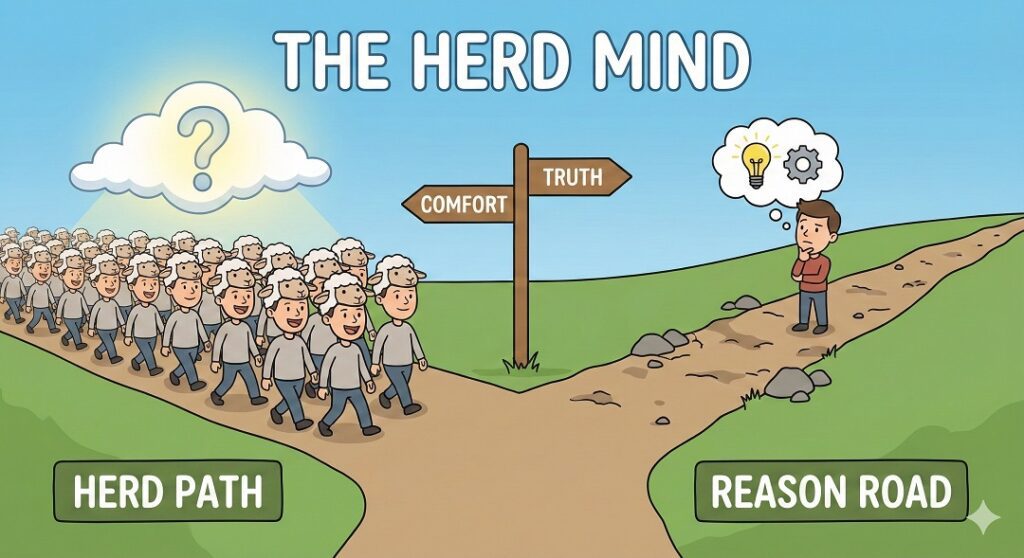
History, however, tells a different story. Entire societies have been confident about ideas that later generations found absurd or horrifying. Practices once defended with moral certainty are now condemned, while views once dismissed as dangerous or foolish were later treated as common sense. The puzzle is not that people make mistakes. The deeper puzzle is this: why do mistaken beliefs feel so unquestionably true while we hold them?
More than a century ago, a British surgeon named Wilfred Trotter attempted to answer this question. His answer was unsettling then, and it remains unsettling now. In his book, Instincts of the Herd in Peace and War (1916), Trotter argued that human beings are not primarily rational creatures who occasionally fall prey to irrational group behaviour. Rather, we are biologically gregarious creatures whose beliefs, morals, and certainties are shaped first by the social group — the herd — and only later defended by reason.
This essay explores that idea. Not as a historical curiosity, but as a framework for understanding how the human belief system actually works.
A Different Question About the Human Mind
Most discussions of irrationality begin with reason and ask why it fails. Why do people ignore evidence? Why do they cling to bad ideas? Why does education not immunise against error?
Trotter asked a different question: why do some beliefs feel so certain in the first place? Why do some ideas arrive in the mind with a sense of obviousness so strong that questioning them feels foolish, immoral, or even dangerous? To answer this, he turned away from philosophy and toward biology.
Herd Instinct Is Not a Metaphor
Trotter’s central claim is simple but radical: gregariousness in humans is a fundamental biological instinct, on par with hunger, fear, or sex. It is not a cultural habit layered on top of human nature. It is part of the machinery.
In social species, survival does not depend solely on the individual organism. It depends on coordination, cohesion, and shared response. Over time, natural selection favours animals that are acutely sensitive to the behaviour and signals of their group. The group becomes the animal’s effective environment. Trotter writes that the herd animal behaves as if separation from the group were itself a form of danger.
To illustrate the power of this instinct, Trotter contrasts the “solitary” animal (like the tiger or the cat) with the “gregarious” animal (like the dog, the sheep, or the bee). The cat is indifferent to the opinion of others; it hunts alone and eats alone. The dog, however, is physically miserable when isolated. It looks for cues, waits for commands, and finds its psychological stability only in the presence of the pack.
The impulse to remain aligned with the group is not learned through reasoning; it is felt directly, as comfort or discomfort, rightness or wrongness. This matters because instinctive forces do not argue their case. They present themselves as self-evident. As Trotter puts it:
“The impulse of an instinct reveals itself as an axiomatically obvious proposition… something which is so clearly ‘sense’ that any idea of discussing its basis is foolish or wicked.”
In other words, instinct does not say “here is an opinion you might consider.” It says “this is how things are.”
How Belief Becomes “Obviously True”
This is the most important idea in the book, and the one that explains much of human behaviour. Trotter observed that instinctive forces do not supply specific beliefs. Instead, they supply certainty. Herd instinct has the peculiar ability to attach that feeling of certainty to almost any belief, provided the belief is socially sanctioned.
He explains this with remarkable clarity: “They may give to any opinion whatever, the characters of instinctive belief, making it into an ‘a priori synthesis’.” Translated into modern language this means: once a belief is backed by the social group we identify with, it does not feel like a conclusion; it feels like a starting point. It feels prior to argument.
This is why disagreements are so emotionally charged. When someone challenges a belief rooted in herd instinct, they are not merely disputing a proposition. They are threatening a source of psychological security. The reaction is not curiosity, but defence.
Reason as a Defense Attorney
If belief does not originate in reason, what role does reason play? Trotter’s answer is blunt: reason usually arrives after belief, not before it. Its function is not to decide what is true, but to justify what is already accepted.
He writes that rational explanations are often mistaken for the cause of belief, when in fact they are secondary constructions. We believe first, and then we explain to ourselves — and to others — why the belief is reasonable. This explains a familiar phenomenon: intelligent people are often more effective at defending bad ideas than unintelligent ones. Intelligence increases the quality of rationalisation, not necessarily the accuracy of belief.
Importantly, this does not mean that reason is useless. It means that reason operates within social constraints. It is far more effective at organising and defending beliefs than at dislodging socially sanctioned ones.
The Mental Conflict: Stable vs. Unstable Minds
This constant tension between the voice of the herd (tradition) and the voice of the individual’s direct experience (reality) creates what Trotter calls “mental conflict.” How we handle this conflict defines our character.
Trotter identifies two primary types of mind that emerge from this struggle: the “Stable-minded” and the “Unstable-minded.”
The Stable-Minded: These individuals resolve the conflict by ignoring experience. They are characteristically insensitive to new ideas and impervious to facts that contradict herd tradition. They are robust, content, and often form the “backbone” of the state—politicians, officials, and pillars of society—because their certainty is unshakable.
The Unstable-Minded: These are the people for whom the conflict remains unresolved. They cannot ignore the reality of their own experience, even when it contradicts the herd. As a result, they often suffer from doubt, “weakness” of will, and social skepticism. Yet, Trotter notes a vital paradox: while the stable-minded provide security, it is only from the “unstable” class—those sensitive enough to feel the friction of truth—that any social progress or new discovery can come.
Why Experience So Often Fails
One of the most counter-intuitive aspects of human psychology is how poorly experience changes minds. Failed predictions, repeated errors, and clear counter-evidence often leave beliefs intact. Trotter explains why. Experience is individual. Belief is collective.
An individual may encounter facts that contradict a belief, but unless those facts are also endorsed by the herd, they carry less psychological weight than tradition, authority, or consensus. Experience competes against a social force that has been reinforced over years or generations. This leads Trotter to a bleak but accurate observation:
“Man is notoriously insensitive to the suggestions of experience.”
This is not because experience is unclear, but because it lacks the emotional authority of the group.
Conscience, Guilt, and Moral Certainty
Trotter extends his analysis beyond belief into morality. He argues that conscience itself is a product of herd instinct. In social animals, approval and disapproval from the group are matters of survival. Over time, these external signals become internalised. The individuals’ actions no longer needs to be watched – the group’s standards operate from within.
This produces guilt, duty, and moral obligation — not as abstract principles, but as felt realities. Trotter illustrates this with a simple comparison. A solitary animal may learn to associate certain actions with punishment. A gregarious animal goes further. It experiences wrongdoing as wrong, even before punishment occurs.
This explains two otherwise puzzling facts:
- Moral certainty varies dramatically across cultures.
- Moral outrage is often strongest where reasoning is weakest.
Conscience does not track universal truth. It tracks social alignment.
The Bee and the Wolf: The Paradox of Altruism
It is easy to view the herd instinct purely as a source of irrational conformity, but Trotter argues it is also the biological source of our noblest quality: altruism. This is the paradox of the herd.
Trotter often contrasts two forms of gregariousness: the aggressive pack-instinct of the Wolf, and the socialized devotion of the Bee. The Wolf represents the mob—aggressive, led by a strong leader, and united only by the pursuit of prey. The Bee, however, represents the ultimate “socialized” animal. The bee does not serve the hive because it calculates that it “pays” to do so; it serves the hive because its individual identity is submerged in the welfare of the whole. It works itself to death not out of fear, but out of a biological passion.
Trotter insists that human altruism is not a “rational” decision to be nice. It is an instinctive drive as fierce as hunger. We are altruistic because we must be. The same instinct that makes us fear public opinion is also the only force capable of making us care for others. Without the herd instinct, humans would be as solitary and indifferent to the suffering of others as the tiger.
Yet, this brings a tragic complication. The same instinct that enables cooperation also enforces conformity. New forms of altruism — new ideas about justice, fairness, or responsibility — threaten existing social arrangements. As a result, societies often respond to moral innovators with hostility. Reformers are labelled dangerous, subversive, or immoral, even when their ideas later become accepted norms. The paradox is that the same instinct produces both moral progress and moral repression.
The Fragility of Civilisation
Perhaps the most striking aspect of Trotter’s work is how modern it feels. Writing during the First World War, he warned that civilisation rests on psychological foundations that are far less stable than we like to believe.
He noted that herd instincts evolved in small groups with direct social contact. Modern societies, by contrast, are vast, abstract, and mediated. Old instincts are asked to operate at a scale they were never designed for. When certainty overwhelms humility, and group loyalty overwhelms evidence, societies become brittle. They lose the ability to correct errors without crisis. Trotter summarised this danger in a single sentence:
“The stability of civilisation is unsuspectedly slight.”
What This Framework Does — and Does Not — Claim
It is important to be clear about what this analysis is not saying. It does not say that humans are incapable of reason. It does not say that truth is merely relative. It does not say that social influence is always harmful.
What it does say is more precise and more uncomfortable: belief is not a neutral outcome of evidence processing. It is a social phenomenon with biological roots. Reason can correct belief, but only when social conditions allow it.
Progress depends not just on better arguments, but on environments where doubt is tolerated and uncertainty is not treated as weakness.
Living With an Uncomfortable Truth
Trotter believed that civilisation advances only when societies learn to value reason more than certainty. This does not mean abandoning conviction or commitment. It means recognising the psychological forces that make conviction feel irresistible.
One line from the book captures this tension perfectly:
“Man is too anxious to feel certain to have time to know.”
The challenge of modern life is not acquiring more information. It is learning to live with uncertainty without retreating into the false comfort of unquestioned belief. That challenge remains unresolved.
The Courage to Doubt
Trotter’s analysis leaves us with a humbling realization: the feeling of certainty is rarely a sign of truth. Often, it is merely a sign that we are safe within the flock. To really think—to truly reason—requires us to do more than just fight our biology; it requires us to transform the social environment itself.
Trotter warns that we cannot simply “breed out” the herd instinct, for that would leave us with the “inhuman rationality of the tiger.” Instead, he suggests a different hope: that rationality itself might one day become a herd passion. We must reach a point where the holding of an unverifiable opinion is as socially “bad form” as a breach of etiquette.
If we can learn to feel the same instinctive shame for prejudice that we feel for cowardice, we lose the smug satisfaction of being “right.” But we gain something far more valuable: the ability to listen, to change, and perhaps, to think for ourselves.
This article draws on ideas from Wilfred Trotter’s Instincts of the Herd in Peace and War (1916), a public-domain work that anticipated many modern insights into social psychology and human belief formation.